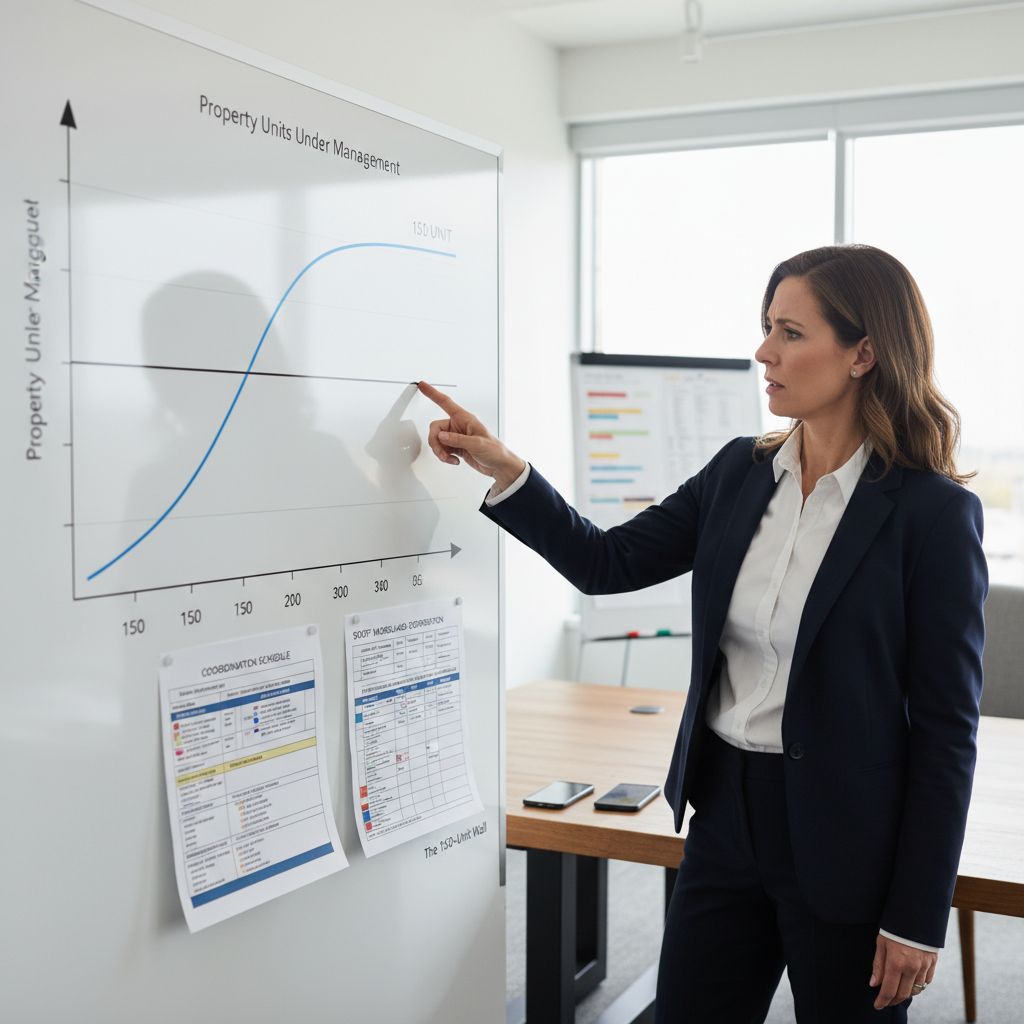
There's an invisible ceiling in property management that most companies hit around 150 units — a point where growth stops not due to lack of demand, but due to operational breakdown.
Industry data confirms this phenomenon: most property management companies struggle to scale efficiently beyond 150 units, despite strong market demand and growth intentions. The companies that break through this barrier don't just grow bigger — they transform their entire operational approach.
The Anatomy of the 150-Unit Wall
The scaling barrier emerges from predictable operational challenges:
- Coordination Complexity: 150 units means coordinating roughly 150 tenants, 150 owners, and 75+ different maintenance requests monthly
- Communication Overload: A 150-unit portfolio generates 400+ monthly communications across tenant requests, owner updates, and contractor coordination
- Quality Control Breakdown: Personal oversight that works for 50 units becomes impossible at 150+
- Administrative Burden: 150+ units require 60+ hours weekly of administrative work without systematic automation
- Staff Burnout: Teams sized for smaller portfolios experience overwhelming stress when stretched across larger inventories
The Numbers Behind the Wall
- 150 units generate approximately 2,300 monthly communication touchpoints
- Average 75–100 monthly maintenance issues requiring coordination
- 150 different property owners expecting personalized attention
- 15–25 after-hours emergency situations monthly
- 450+ monthly lease, financial, and compliance activities
Case Study: The Growth That Almost Killed a Business
Jennifer Walsh of Walsh Property Management in Ottawa experienced the 150-unit wall firsthand. Her company had grown from 80 to 180 units in 18 months, but success nearly destroyed her business:
- Client complaints increased 340% despite same service intentions
- Staff turnover hit 60% as team members burned out
- Emergency response times doubled as coordination became unmanageable
- Profit margins declined despite revenue growth due to operational inefficiencies
"We were drowning in our own success. Every new client made existing service worse." — Jennifer Walsh, Walsh Property Management
The Traditional "Solutions" (And Why They Fail)
Hiring More Staff: Additional coordinators increase overhead but often create more communication complexity without solving systematic issues.
Multiple Software Tools: Adopting different platforms for different functions — tenant communication, owner reporting, maintenance tracking, financial management — increases rather than decreases complexity through fragmentation.
Geographic Concentration: Limiting growth to specific areas reduces travel time but doesn't address communication and administrative challenges.
The Technology Revolution: How Winners Break Through
Companies successfully scaling beyond 150 units share common technological approaches:
Unified Communication Platforms
Instead of juggling phone calls, emails, texts, and various apps, successful companies implement unified systems that manage all stakeholder communications through single interfaces.
Automated Workflow Management
Every routine task — maintenance request intake, trade dispatching, owner updates, rent collection — follows automated workflows that require human judgment only for exceptions.
AI-Powered Triage
Machine learning systems categorize incoming communications, prioritize urgent situations, and route requests to appropriate team members or automated responses without manual review.
Real-Time Analytics
Dashboards providing instant visibility into portfolio performance, response times, tenant satisfaction, and financial metrics allow management by exception rather than constant manual monitoring.
The Walsh Property Management Turnaround
After implementing unified property management technology, Walsh Property Management's results after 6 months:
- Portfolio growth: 180 → 310 units with the same core team
- Client complaints: Down 78% from peak levels
- Staff turnover: From 60% → 15% annually
- Emergency response time: Reduced by 65%
- Profit margins: Improved 22% through operational efficiency
Building Your Scaling Infrastructure
- Audit current operations: Document where time is spent and identify highest-volume, most repetitive tasks
- Implement unified communication: Consolidate all stakeholder communications into single platform
- Automate routine workflows: Build automated processes for maintenance intake, owner reporting, and rent processing
- Establish quality metrics: Define and track KPIs that maintain service quality as volume grows
- Plan team structure for scale: Design roles and responsibilities for 250+ unit operations before you get there
The 150-unit wall isn't a ceiling — it's a filter. The companies that break through don't just add technology; they fundamentally transform how property management works. The question isn't whether you'll hit the wall; it's whether you'll be prepared to break through it.